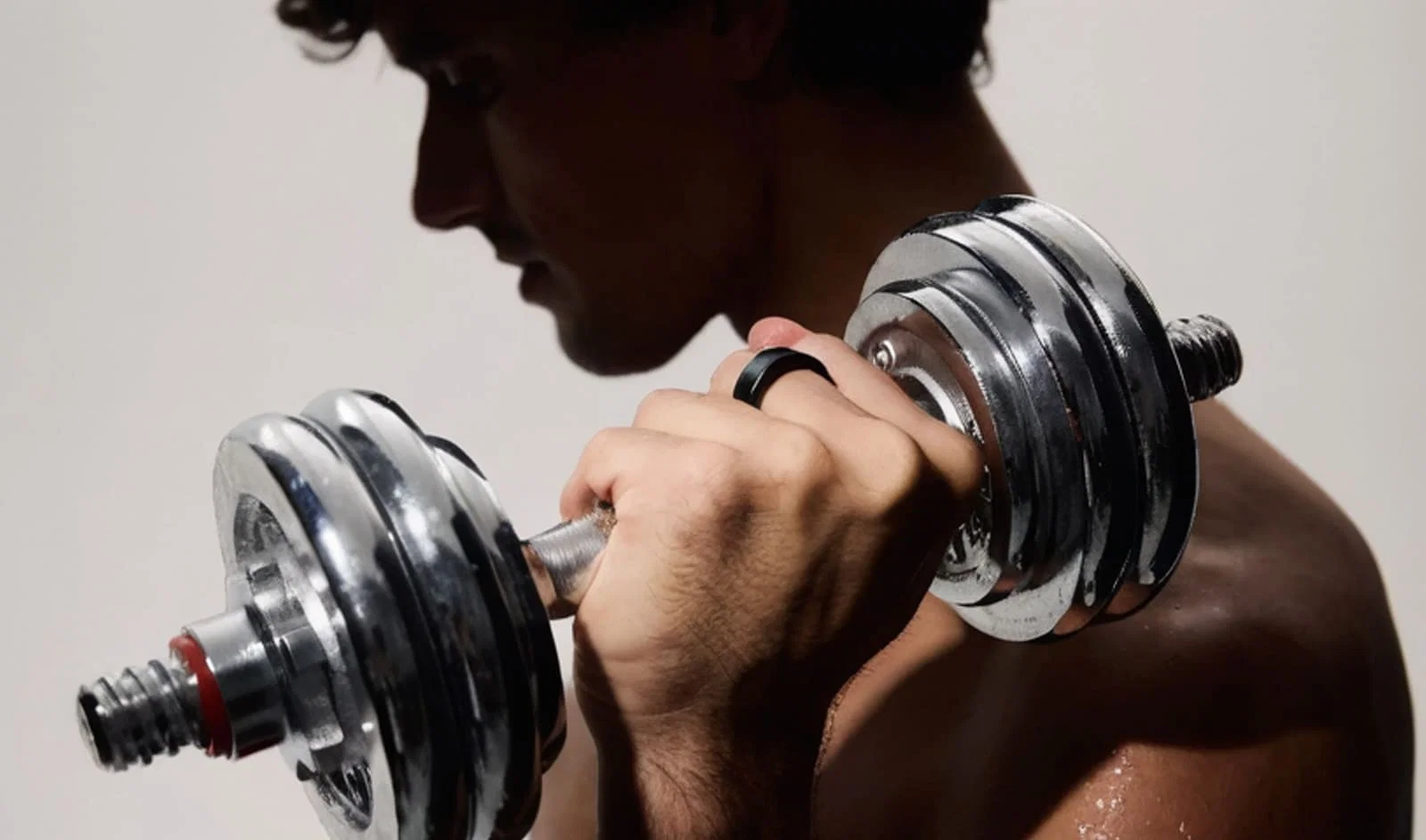
A smart ring can have sophisticated sensors and powerful algorithms, but those technologies still depend on something much simpler: how well the ring fits your finger.
For optical sensors such as photoplethysmography (PPG), consistent contact between the sensor and the skin helps maintain a stable measurement environment. If a ring moves too much, leaves gaps between the sensor and skin, or applies excessive pressure, the optical signal can become more difficult to interpret.
This becomes particularly important during everyday activities. Finger size can change with temperature, fluid shifts, sleep, and exercise. A ring that fits comfortably at one moment may feel different several hours later.
That is where adaptive fit becomes important. Instead of relying entirely on one fixed ring size, an adaptive sizing structure is designed to accommodate normal changes in finger circumference while helping the sensors remain consistently positioned against the skin.
Key Takeaways
Finger circumference can change throughout the day.
Temperature, sleep, activity, and normal fluid shifts can affect how a ring feels.
Excessive movement between the sensor and skin can introduce variability into optical measurements.
Excessive pressure can also make a ring uncomfortable to wear for extended periods.
Stable skin-to-sensor contact provides a more consistent environment for PPG-based measurements.
Adaptive fits helps a smart ring accommodate normal changes in finger size.
The CIRCUL RING 2 MAX uses an Adaptive Sizing Structure designed for comfortable, stable wear.
Consistent fit is particularly valuable when collecting measurements over long periods.
Why Smart Ring Fit Matters for Continuous Health Tracking
Daily Finger Swelling and Sizing Fluctuation
Your finger does not remain exactly the same size throughout the day.
Temperature can affect circulation and how your fingers feel. Physical activity can temporarily change blood flow and finger circumference. Overnight, changes in body position and fluid distribution may also affect how a ring fits.
These changes are normal, but they create a design challenge for smart rings.
A fixed ring size has to accommodate these changes without becoming uncomfortably tight or loose. If the fit becomes too loose, the ring may move more freely on the finger. If it becomes too tight, extended wear may become uncomfortable.
For a device designed to collect health and wellness data over long periods, maintaining a comfortable and reasonably stable position matters.
Finger-Based Optical Sensing
Smart rings commonly use optical sensors to measure signals from tissue beneath the skin. PPG, or photoplethysmography, works by using light to observe changes associated with blood volume in tissue.
The quality of the resulting signal depends on more than the sensor itself. Sensor position, skin contact, movement, and the surrounding optical environment can all influence the measurement.
This is one reason finger-based wearables pay close attention to fit and sensor placement.
The finger provides a practical location for a compact wearable because it allows the optical sensing system to remain close to the tissue being measured. However, the ring still needs to stay appropriately positioned as the wearer moves throughout the day.
The Limitations of Fixed Ring Sizing
Traditional smart rings generally use fixed ring sizes. Once you choose a size, the physical circumference of the ring does not dynamically change with your finger.
That creates a familiar trade-off.
A ring that is too loose may rotate or shift more easily. A ring that is too tight may become uncomfortable when your finger becomes larger during certain periods of the day.
Neither situation is ideal for a wearable designed to remain on your finger for extended periods.
The goal is therefore not simply to make a ring smaller or larger. The goal is to create a fit that can accommodate normal changes while maintaining comfortable and stable sensor contact.
How Fit Can Affect Optical Signal Quality
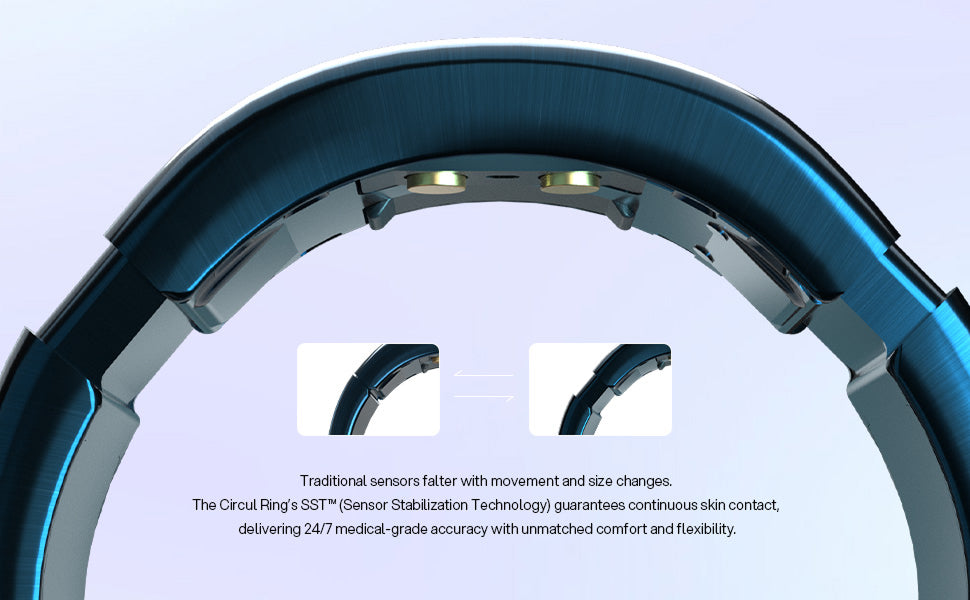
Ambient Light and Sensor Contact
PPG sensors work with controlled light interacting with tissue. Because of this, the optical environment around the sensor matters.
When a ring moves significantly or a gap develops between the sensor and the skin, the relationship between the sensor and the measurement site can change. Unwanted ambient light and changes in the optical path can add noise to the signal.
This does not mean that every small movement automatically invalidates a measurement. Modern wearable systems use signal-processing techniques to account for noise and motion. However, maintaining a stable physical relationship between the sensor and skin provides a more consistent starting point for those algorithms.
This is particularly relevant for measurements collected repeatedly over long periods.
Movement and Motion Artifacts
Movement presents another challenge.
When your hand moves, the ring and the underlying tissue may move relative to each other. This can change the optical path and introduce motion-related artifacts into the PPG signal.
A stable fit can help reduce unnecessary sensor movement.
The relationship can be understood simply:
Stable fit → more consistent sensor positioning → more consistent optical conditions → a cleaner measurement environment
The fit does not replace signal processing or sensor technology. Instead, it supports them.
Tight rings fail differently. Heavy pressure squeezes small vessels. Squeezing reduces local blood volume. Sensors get weak pulse waves.
Squeezed vessels flatten blood waves. Sensor algorithms miss true peaks. Signal loss changes wave amplitude. Bad amplitude ruins stress tests. It ruins blood pressure tracking. Good blood flow keeps signals strong.
Why Excessive Pressure Is Also a Problem
A smart ring should not simply be as tight as possible.
Excessive pressure can make extended wear uncomfortable and may alter the local conditions around the sensor. This is particularly important for a device intended to be worn during sleep, exercise, and normal daily activities.
A good smart ring therefore needs to balance two requirements:
enough contact for stable sensing;
enough flexibility to remain comfortable as finger size changes.
That balance is one of the key reasons adaptive fit is useful.
How Adaptive Fit Improves Comfort and Signal Quality

Adaptive Fit vs. Fixed Sizing
The CIRCUL RING 2 MAX uses an Adaptive Sizing Structure designed to accommodate changes in finger circumference.
Instead of treating ring size as completely static, the adaptive structure allows the ring to respond to normal changes in finger size while maintaining a more consistent fit.
The official CIRCUL sizing system uses S / M / L, with the adaptive structure designed to cover a broad range of finger sizes.
This approach can be especially useful for people who notice that a conventional fixed-size ring feels different at different times of the day.
Maintaining Stable Skin-to-Sensor Contact
For optical sensing, consistent positioning matters.
The CIRCUL RING 2 MAX combines its adaptive fit structure with SST™ Ultra 2.0, or Sensor Stabilization Technology, to support stable sensor positioning against the skin.
The basic principle is straightforward:
Adaptive fit
↓
More consistent sensor positioning
↓
Stable skin-to-sensor contact
↓
A more consistent optical measurement environment
The objective is not to eliminate every possible source of measurement variation. Rather, it is to address one of the physical variables that a wearable can control: how consistently its sensors sit against the skin.
Adaptive Fit and Continuous Monitoring
Fit becomes even more relevant when a device is designed for continuous monitoring.
The CIRCUL RING 2 MAX provides true 24/7 continuous monitoring of HR, HRV, and Body Energy.
When measurements are collected continuously rather than as isolated snapshots, the physical relationship between the device and the body becomes an important part of the overall measurement system.
A ring that remains comfortably positioned throughout daily activities can provide a more consistent basis for observing changes over time.
This is one reason fit should be considered part of wearable sensor design rather than simply a matter of comfort.
How PPG Technology Works With Adaptive Fit
The CIRCUL RING 2 MAX uses 3-Wavelength PPG technology.
PPG uses light to observe changes associated with blood volume in tissue. Different wavelengths can provide information used by the sensing system for different measurements, including heart rate and SpO₂.
But the sensor does not work in isolation.
The complete measurement system involves:
The optical sensor emitting light.
Light interacting with tissue.
Reflected light being detected by the sensor.
Signal-processing algorithms interpreting the resulting waveform.
The wearable presenting the resulting health and wellness information.
The physical fit of the ring influences the environment in which the first several steps occur.
This is why sensor engineering and mechanical design need to work together.
Fit and Sleep Tracking
Sleep presents a particularly interesting challenge for smart rings.
During sleep, users generally do not consciously adjust the position of the ring. The device may also experience changes in hand position, body position, and finger circumference over several hours.
A comfortable and stable fit therefore matters for overnight sensing.
The CIRCUL RING 2 MAX supports sleep stages, Sleep Debt, and Sleep Recovery Assessment, while also providing nighttime continuous SpO₂ monitoring.
For sleep-related breathing insights, CIRCUL uses the term Sleep Apnea Risks Assessment. This refers to a risk assessment rather than a medical diagnosis.
Stable positioning can support the consistency of overnight sensor measurements, but fit alone should not be presented as a guarantee of measurement accuracy.
Verifying Your Smart Ring Fit in Daily Life
You do not need specialized equipment to get a general sense of whether your smart ring fits comfortably.
The most useful question is simple:
Does the ring stay comfortably positioned without feeling excessively tight?
The Rotation Check
Gently try to rotate the ring around your finger.
A well-fitted ring should have some resistance rather than spinning freely, while still allowing comfortable movement.
If the ring rotates extremely easily or repeatedly changes position during normal activity, it may be worth reassessing the size or placement.
At the other extreme, if rotating the ring causes significant discomfort or pulls the surrounding skin, the fit may be too tight.
The goal is a stable but comfortable fit—not maximum pressure.
The Fist and Movement Check
You can also observe how the ring feels during ordinary hand movements.
Make a fist and notice whether the ring becomes uncomfortably tight. Then move or shake your hand naturally and see whether the ring shifts excessively.
These simple checks can help you understand how the ring behaves as your finger changes position and circumference.
For the CIRCUL RING 2 MAX, the Adaptive Sizing Structure is designed to accommodate these everyday changes while maintaining a comfortable fit.
Good sensor fit helps track health well. Your ring must touch skin constantly. Clean light signals need steady contact always. Learning Why Smart Ring Fit Matters: How Adaptive Fit Improves Comfort, Signal Quality and Measurement Accuracy guides you. You pick gear with clear data. It causes no pain. Smart fit fixes big problems. It changes shape on your finger.
Why Fit Matters More Than You Might Think
Smart ring performance is often discussed in terms of sensors, algorithms, battery life, or app features.
Those things matter. But there is another part of the system that is easy to overlook: the physical connection between the device and your body.
A sophisticated sensor cannot operate independently of its measurement environment.
For optical sensing, the distance and relationship between the sensor and skin matter. For long-term monitoring, the device also needs to remain comfortable enough that people actually wear it consistently.
That makes adaptive fit more than a comfort feature.
It is part of the overall sensing architecture.
The CIRCUL Approach to Adaptive Fit
The CIRCUL RING 2 MAX brings together several elements of this design philosophy:
Adaptive Sizing Structure for changing finger circumference
SST™ Ultra 2.0 for sensor stabilization
3-Wavelength PPG for optical sensing
True 24/7 continuous monitoring of HR, HRV, and Body Energy
Nighttime continuous SpO₂ monitoring
Sleep stages, Sleep Debt, and Sleep Recovery Assessment
Cuff-free blood pressure monitoring for wellness reference
Together, these technologies are designed around a simple principle: a wearable should be able to collect meaningful information without requiring the wearer to constantly think about the device.
FAQ
How does the CIRCUL RING 2 MAX adapt to finger swelling?
The CIRCUL RING 2 MAX uses an Adaptive Sizing Structure that allows the ring to accommodate normal changes in finger circumference.
The purpose is to maintain a comfortable and stable fit across different everyday conditions rather than relying entirely on a fixed ring circumference.
Why is skin contact important for smart ring measurements?
Optical sensors such as PPG depend on light interacting with tissue. Significant changes in sensor position or gaps between the sensor and skin can alter the optical measurement environment.
Stable contact helps provide a more consistent basis for the sensing system.
Can a fixed-size smart ring still provide useful measurements?
Yes. Fixed-size smart rings can still collect useful measurements.
The challenge is that finger circumference naturally changes throughout the day. An adaptive fit structure is designed to accommodate those changes and help maintain a more consistent fit over extended wear.
Does a better fit guarantee more accurate health data?
No wearable fit can guarantee perfect measurement accuracy.
Fit is one factor among many, alongside sensor design, signal processing, skin characteristics, movement, device placement, and measurement conditions.
What adaptive fit can do is help create a more stable physical environment for the sensing system.
The Bottom Line
A smart ring is not simply a collection of sensors inside a small piece of hardware.
It is a complete system in which mechanical design, sensor placement, optical sensing, signal processing, and long-term wearability all work together.
That is why adaptive fit matters.
By accommodating normal changes in finger size while supporting stable sensor positioning, an adaptive sizing structure can help balance comfort and sensing consistency.
For the CIRCUL RING 2 MAX, this approach is part of a broader sensing architecture that combines Adaptive Sizing Structure, SST™ Ultra 2.0, 3-Wavelength PPG, and true 24/7 continuous monitoring of HR, HRV, and Body Energy.
The goal is not simply to make a ring that fits.
It is to make a wearable that can stay comfortably connected to you as your day—and your body—changes.
Wellness Disclaimer
CIRCUL RING provides wellness and lifestyle insights and is not intended to diagnose, treat, cure, or prevent any disease or medical condition. Health measurements and insights should not replace professional medical advice, diagnosis, or treatment.